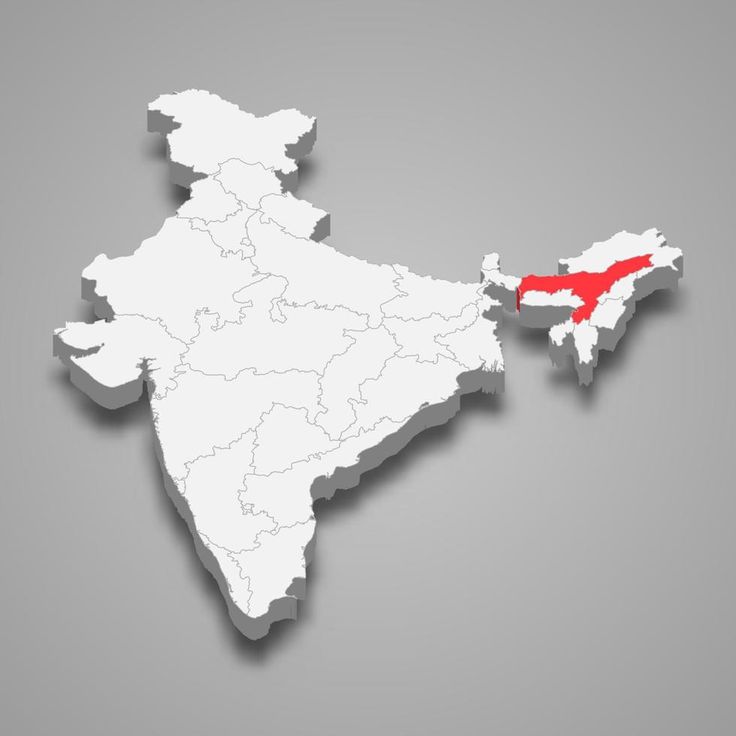
"The Land of Red Rivers and Blue Hills"
Key details about Assam's upcoming legislative assembly elections
Understanding the state's diverse political, cultural, and geographic landscape
Assam, the gateway to Northeast India, is a land of extraordinary natural beauty — rolling tea gardens, the mighty Brahmaputra river, the world-famous Kaziranga National Park (home to the one-horned rhinoceros), and the mystical Kamakhya temple. Its political landscape is equally dramatic, shaped by ethnic diversity, immigration debates, insurgency histories, and a rapidly shifting electoral arithmetic.
For much of post-Independence India, Assam was dominated by the Indian National Congress. The late 1970s and 1980s were defined by the Assam Agitation — a mass movement against illegal immigration — that culminated in the historic Assam Accord of 1985 and the rise of the Asom Gana Parishad (AGP). The Congress returned to power and alternated with AGP for decades before the BJP's dramatic breakthrough in 2016 under Sarbananda Sonowal.
In 2021, the BJP-led NDA retained power with a commanding majority, making Himanta Biswa Sarma the Chief Minister. This cemented Assam's transformation into a BJP stronghold in the Northeast — a remarkable shift for a state that had been Congress-dominated for generations.
The National Register of Citizens (NRC) and the Citizenship Amendment Act (CAA) have been defining electoral fault-lines in Assam. While large sections of the indigenous Assamese community supported the NRC to identify illegal immigrants, the CAA's provisions for non-Muslim minorities created new tensions. These issues will continue to shape the 2026 campaign narrative across the Brahmaputra valley and the Barak valley.
Assam's economy is anchored by tea (it produces over 50% of India's total tea output), petroleum extraction, agriculture (rice, jute, oilseeds), and a fast-growing services sector. Guwahati, the commercial capital, is emerging as a major logistics and startup hub for the entire Northeast. Tourism — centred on Kaziranga, Majuli (the world's largest river island), and heritage temples — is also a significant growth sector.
With 126 assembly constituencies spread across 35 districts, Assam's electoral map is one of the most complex in India. It encompasses diverse communities — Assamese Hindus, Bengali Hindus, Muslims (largely from Bengali-speaking communities in the char areas), indigenous tribal groups (Bodos, Karbis, Dimasas), and tea garden workers. Managing coalition arithmetic across these identities is the central challenge for every political party.
The 2026 Assam elections will test whether the BJP can secure a historic third consecutive term in a state that rarely re-elects governments. Chief Minister Himanta Biswa Sarma's aggressive governance style, welfare delivery through schemes like Orunodoi, and the opposition's ability to unite under the Congress-AIUDF or a broader INDIA bloc alliance will be the defining factors. Seats in the Barak valley, the riverine char areas, and the Autonomous Hill Districts will be critical battlegrounds.
Current distribution of seats in the Assam Legislative Assembly
Full list of 126 constituencies – current delimitation (2026 elections)
| No. | Constituency | District | Lok Sabha Constituency |
|---|
Critical factors that will shape the upcoming elections
The unresolved NRC process and the rollout of CAA remain the most emotionally charged issues. How parties position themselves on citizenship and identity will decisively influence voting patterns across the Brahmaputra valley.
Annual Brahmaputra floods devastate millions of lives and livelihoods. Sustainable flood management, embankment repairs, erosion control, and rehabilitation of displaced communities are perennial voter demands.
Youth unemployment remains high despite economic growth. Expanding manufacturing, leveraging Guwahati as a logistics hub, and ensuring fair wages for tea garden workers are key campaign battlegrounds.
Demands for greater autonomy, land rights, and cultural preservation from Bodo, Karbi, Dimasa, and other indigenous communities — particularly in the Hill Districts and BTR — will shape seat outcomes significantly.
With over a million tea garden workers concentrated across Upper Assam constituencies, wages, healthcare, housing, and dignified working conditions for this historically marginalised community remain a crucial vote bloc issue.
Road, rail, and bridge connectivity across the Brahmaputra, digital infrastructure rollout in rural districts, and Northeast-focused central investment schemes will all be central to the development narrative.